
By Sandra Marsian
Former Vice President, Travel, Marketing & Membership for AAA Pioneer Valley
Maine’s promise of craggy seaside cliffs, endless beaches, morning sea smoke and the comingled scents of pine, flowers and ocean musk make it idyllic for a summer vacation.
Considering Maine’s 3,500 miles of rugged coastline is dotted with over 60 historic lighthouses, a scenic road trip to see a selection of these magical beacons seems fitting.
A lighthouse pilgrimage
Make your first stop in Portland, the state’s largest city and home to the iconic Portland Head Light, first lit in 1791. Located in Fort Williams Park, this lighthouse is the oldest in Maine and considered the most photographed in the United States. The park offers expansive ocean views, picnic spots and cliffside trails perfect for stretching your legs. An award-winning museum is nestled within the former keeper’s quarters.
Overlooking the sea from this massive light also afforded me a distant view of Ram Island Ledge Light built in 1905, where rough seas can send waves crashing over the lantern room.
Portland offers a wide array of fine dining options, breweries, museums, and a vibrant music and art event schedule so check out www.visitportland.com to make the most of your time here.
Heading north along U.S. Route 1, make your next stop the quaint town of Cape Elizabeth to see the Cape Elizabeth Lighthouse, now privately owned, from Two Lights State Park. The twin 65-foot stone lights rising 130 feet above sea level were erected in 1828 to replace a 50-foot-tall rubblestone and lime mortar tower. The western tower flashed for 45 seconds on, then off, while the eastern tower 300 yards away displayed a constant light. Vessels entering Portland Harbor could line up the lights to ensure they were securely on route.
Continue to Boothbay Harbor, where the 30-foot-tall, conical shaped Burnt Island Light has stood watch since 1821. Accessible by boat or kayak only, the granite and brick tower built in 1821 gives visitors a glimpse into lighthouse life, with a restored keeper’s house and interactive programs. Boothbay Harbor itself is a lively town with art galleries, seafood restaurants, and whale watching excursions, making it well worth a stop.
Pemaquid Point Light awaits in Bristol and is famous for its dramatic location perched upon jagged rocks, and yes, for a modest fee you can climb it, presuming you are at least 46” tall. For Maine maritime history artifacts, pop into the adjacent Fishermen’s Museum. Or peruse the Art Gallery featuring local artists. Visit BristolMaine.org for information.
Rockland Harbor is home to Owls Head Lighthouse, commissioned by President John Quincy Adams in 1824, and costing a mere $2,707.79. It is now the residence of the American Lighthouse Foundation and listed on the National Register of History Places.
This white, cylindrical brick tower with black lantern has endured many renovations and is known to be haunted. Visitors may climb its wooden steps for panoramic views of the Penobscot Bay. While in Rockland, take time to review the most extensive collection of lighthouse memorabilia in the country at The Maine Lighthouse Museum.
No road trip to Maine’s historic lighthouses would be complete without a stop in Tremont to see the 37 foot tall Bass Harbor Head Light Station, on the southern tip of Mount Desert Island. Built in 1858 and now managed by Acadia National Park, this park highlight can be busy and parking tight so bring your walking shoes and patience. Iconic Acadia, one of the top 10 most visited US national parks, offers 158 miles of hiking trails, 27 miles of historic motor roads and 45 miles of carriage roads.
West Quoddy Head Light in Lubec marks the easternmost point in the continental United States, and where the sun rises first each morning. It is a candy cane style lighthouse boasting bold red and white stripes. Such lighthouse markings made for unique messages to seafarers that they were on the right course. Many visitors make their pilgrimage during first light to capture sunrise lighthouse photos with a coastal backdrop. Here you can also hike rugged coastal trails. This is my personal favorite as it is located just 2 miles from my second home, from which I can see the next featured light.
Lubec Channel Lighthouse, aka “The Spark Plug”, is only one of three remaining wedding cake or spark plug style lights in Maine, earning a spot on the National Register of Historic Places due to its historic importance to the Maine shipping industry. Completed in 1890 as navigational aid for the Lubec Narrows, it is a cast iron conical tower with five levels, two of which made the keepers’ quarters. Nestled in the shallow channel between South Lubec Beach and Campobello Island, the treacherous waterway was heavily trafficked by boats bound for Lubec’s sardine factories. Although privately owned and surrounded by water, this light can be easily viewed from beaches along South Lubec Road.
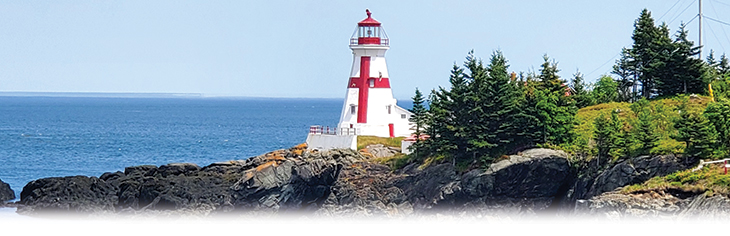
From Lubec, the Roosevelt International Bridge brings you to Campobello Island, home of Head Harbour Lightstation, the oldest surviving wooden lighthouse in New Brunswick, Canada. This 51-foot, octagonal lighthouse built in 1829 is the second oldest in Canada. White and adorned with a bold red St. George’s Cross serving as a day mark, this light was visible even in the thickest Bay of Fundy fog.
Do stop at Roosevelt Campobello International Park while on island to tour Franklin and Eleanor Roosevelt’s magnificent summer home. Tours are free and The Prince Café in the historic Prince Cottage, is a lovely place to enjoy lunch. While departing the island, stop at Mulholland Point Lighthouse, built in 1884. A white wooden octagonal tower standing 44 feet from its base to the vane is positioned near the southern end to guide vessels through the Lubec Narrows; the small passage between the island and the United States mainland.
This means, even if you leave your passport at home, you can still gaze upon this petite lighthouse from Water Street, Lubec, Maine.
You can even sleep in a lighthouse
Maine’s Bureau of Parks and Lands offers many free, first-come-first-service camping options throughout the state that are beautifully maintained. Better yet, lean into your lighthouse themed holiday and sleep in one. Maine offers several historic lighthouses where you can stay overnight, combining coastal charm, panoramic ocean views, and a unique maritime experience. Visit https://uslhs.org/travel/lighthouse-accommodations/maine for a listing of options.
So, if you are looking for a different way to experience Maine, consider a winding journey to celebrate these stars of maritime history. A perfect vacation idea for history buffs, photography enthusiasts or those who just love a scenic drive.