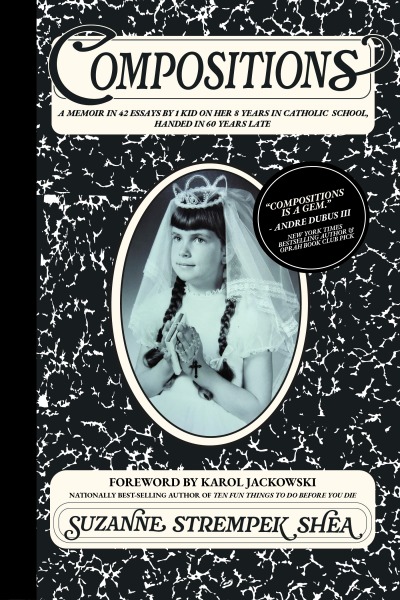
“Compositions”
A conversation with Suzanne Strempek Shea
It launched with a standing-room-only audience of friends, fans and fellow writers in her hometown library. A reading and book signing with fellow nonfiction and memoir writer Madeline Blais at South Hadley’s famed Odyssey Bookshop sold out long before the appearance date. Orders started coming in for copies as soon as word about the book, and its author, began to spread online and in print.
And the appearances and book signings just kept resulting in rave reviews.
Who knew a memoir of friends, family and Catholic school would create such a buzz?
Sometimes it’s not the topic, but the writer, and in the skilled hands of local celebrity author Suzanne Strempek Shea, elementary school memories have blossomed into a book that captures a simpler time, and one that so many readers across generations can relate to.
“Compositions: A Memoir in 42 Essays by 1 Kid on Her 8 Years in Catholic School, Handed in 60 Years Late,” is the memoir of Strempek Shea’s eight years of Polish Catholic school in her native village of Three Rivers. This 12th book in a 32-year career as an author is among the many she has set in Western Massachusetts, starting with her first novel, the critically acclaimed “Selling the Lite of Heaven.”
Encompassing her first eight years of school, from the mid-1960s to early ’70s, “Compositions’” humorous and poignant essays show a past still fully present. Graduation photos lining the walls of the school include students’ parents who once sat in the same classrooms with the same wooden desks, same windows, same blackboards, and some of the same nuns. In those rooms, she learns new words — bubbler for water fountain, sodality for club, lavatory for bathroom, Father for priest, even if he wasn’t hers. As the years go by, she realizes she likes school, thanks in part to the nuns who taught patiently, sang folk songs beneath a tree, and danced the hula, and despite the ones who wielded a croquet stick or hurled textbooks. And in that cloistered world of Catholic school and faith-filled family, reverence is everywhere: dropped bread receives a kiss, swimmers bless themselves before diving, parishioners walk on their knees each Good Friday. The miracles in?”Compositions”?that she prays for — a horse or at least a pony, her grandfather’s health — never take place. Yet something no less tender and beautiful does as she spins that precious childhood in a kaleidoscope of close-to-the-bone observations and stories.
Prime spoke with Strempek Shea about “Compositions” as she was embarking on her book launch tour. Here’s what she shared:
Q: Your latest nonfiction book focuses yet again on something you experienced right here in Western Massachusetts, but it’s very different in being a childhood story. How did the idea come to you?
"I was visiting a friend I’ve known since the first day of first grade, Robbie (Roman) DuComb of Monson, and as I was leaving, the picture came to me of one of those expandable drinking cups we used to keep in our pockets as kids. I asked if she remembered them, we had a little reminiscence, and I got into my car. On the 20-minute ride home, I thought about being in line with one of those cups at the water fountain at our parochial school, the former Saints Peter and Paul School in Three Rivers, and how the nuns called it a bubbler, and all the different words I learned, both in English and Polish, in those eight years there. I got home and began writing what became the first chapter of the book, titled “New Words,” and then I was off.
I’d go to sleep remembering so much from those years, and I’d wake up and write"
Q: You started your career as a newspaper reporter. How does that experience lend itself to your work now, including this book?
"Every day, I had to come up with at least two stories from the beat I was covering, and over 15 years that included sports, fashion, crime, courts and towns. It got an idea wheel turning in my head, and I was rarely out of ideas. It’s all rooted in curiosity, something I saw daily in my house, living with lifelong Springfield Newspapers journalist Tommy Shea. Neither of us studied journalism, but there we were, asking questions for a living: What’s that? Why did it happen? Who’s she? Why’s she doing that? Thinking like that all the time can lead to other questions, like 'Do you remember those expandable drinking cups?' And then you can be off to writing a whole book."
Q: What do you hope readers will take away from your essays?
"I see them as comprising a time capsule of those years, in a community rooted in immigration, and from the point of view of a child learning new words, and all other kinds of new things, daily in her home, her school and her church. Readers won’t need to have grown up in the same type of community or religion to connect with the story, as kids are kids everywhere, with the same sense of wonder, grappling with all the concepts introduced by adults, hoping to fit in, and looking forward to doing their favorite things. I hope readers might want to reflect on that formative time in their lives and write their own time capsules."
Q: Of the 12 works that bear your name, do you have a favorite?
“Selling the Lite of Heaven” began as one of my first short stories, something I wouldn’t have tried to write if I hadn’t taken my mom’s advice about any endeavor: “Give it a try, you’ll never know what you can do if you don’t try.” I gave it a try, and look what happened."