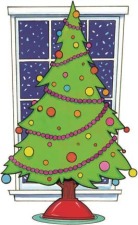
O Tannenbaum, how sustainable are thy branches (and thy lights, too!)
By Tim Lessard
Special to PRIME
'Tis the season.
For the holidays we're going to help you improve both of your homes.
The house you live in and the planet you live on.
Yes. We're talking a green Christmas.
And yes, it is possible to enjoy the holidays and yet reduce your carbon footprint.
The trashiest time of year
We don't need to get all puritanical about it, but here's how it is. Every week from Thanksgiving through Christmas we Americans produce an extra 2 billion pounds of trash.
However, if each of us replaced just one gift with a card, a movie ticket or anything else that fits in a single envelope, collectively we would eliminate 50 million tons of trash.
If each of us used just two feet less ribbon this season, the 38,000 miles saved would be enough to wrap the planet itself in a big Christmas bow. A green bow.
Trees live or artificial?
Let's keep it simple, though. Let's just pay attention to one of the focal points of the season.
The Christmas tree.
The first one to be decorated was in Riga, Latvia, in 1510.
Later, in early New England, Christmas was banned by law for 22 years so no one would have too much fun. No Christmas trees at all then. Oh, those Puritans. Always thinking so hard about things.
By the way, ever wonder why there's no Christmas tree in the famous "Twas the Night Before Christmas"? Because it was written in 1823, 28 years before the first commercial Christmas tree lot opened in New York in 1851.
For a long time many of us thought that artificial trees were the most ecologically friendly way to go. They're perennially re-usable and they don't deprive live trees of their carbon dioxide production.
However, we've discovered artificial trees have drawbacks. They're made of non-renewable materials usually PVC, a petroleum based plastic and contain known carcinogens such as dioxin, ethylene dichloride and vinyl chloride. In other words, anathema to reducing your carbon footprint.
These days 85 percent of artificial trees are manufactured in China, where workers make about $125.00 a month under Scrooge-like sweatshop conditions. Not exactly a "Ho, ho, ho" work environment.
Even Santa's elves do better than that.
Pick live and go "green"
Most live trees are grown on tree farms today and while they're growing, they replenish the air with oxygen. One acre of trees produces enough oxygen for eighteen people. Usually these tree farms are on rocky soil not rich enough for other agriculture, so this otherwise barren land is being used to produce oxygen that combats global warming instead of just sitting there unproductive.
If you're concerned about pesticides, though, you can always purchase an organic tree; but according to Ohio State University researchers, the pesticides used are minimal enough that they degrade rapidly during composting.
You can also buy a living, potted tree. However, you can only keep one inside from four to ten days, depending on the type, and then you have to replant it again outside. There it will grow too fast, though, and be too tall to be used again next year inside your house.
Probably a live, cut tree is therefore the most practical and the most environmentally conscientious choice.
Smart illumination
Once your tree is up and the fresh scent of the evergreen pervades your home, decorate it with LED lights.
Light emitting diodes (LED lights) came on the market in 2001. Because they use semiconductor material, like computer chips, rather than incandescent filaments, they produce very little heat and don't contribute to global warming.
If you use traditional holiday lights for 30 days, you pay about $18.00 in extra electrical costs. The same number of LED lights for the same period of time, however, would cost you only 19 cents. Over 98 percent savings.
If each of us replaced our conventional Christmas lights with LED's, 2 billion kilowatt hours would be saved in the month of December alone. That's enough electricity to keep 200,000 homes in electricity for a year.
These lights also last between 100,000 and 200,000 years. Pretty good investment, huh?
If you just attend to these two things your tree and your lights you'll reduce your carbon footprint this holiday down to the size of an elf's.
Think about it.
But not too hard, and not too long. Christmas is legal again in this country. It's time to have fun.
Ho, ho, ho.
Tim Lessard is a Master Plumber and the president of Lessard Home Solutions of Springfield. Visit his web site at www.lessardhomesolutions.com/ or call him at 413.736.0066. Tim can also be heard on John Walter's Home Improvement Show on WMAS AM the second Saturday of every month at 11:00am.